What Polymarket actually charges
Polymarket charges a fee only to takers, and only on some markets. It varies with the price of the contract, so the same trade costs different amounts depending on how likely the market thinks the outcome is. Makers are never charged. The rates below were re-derived from Polymarket's own published tables and checked against every cell of them on 2026-08-27.
The formula
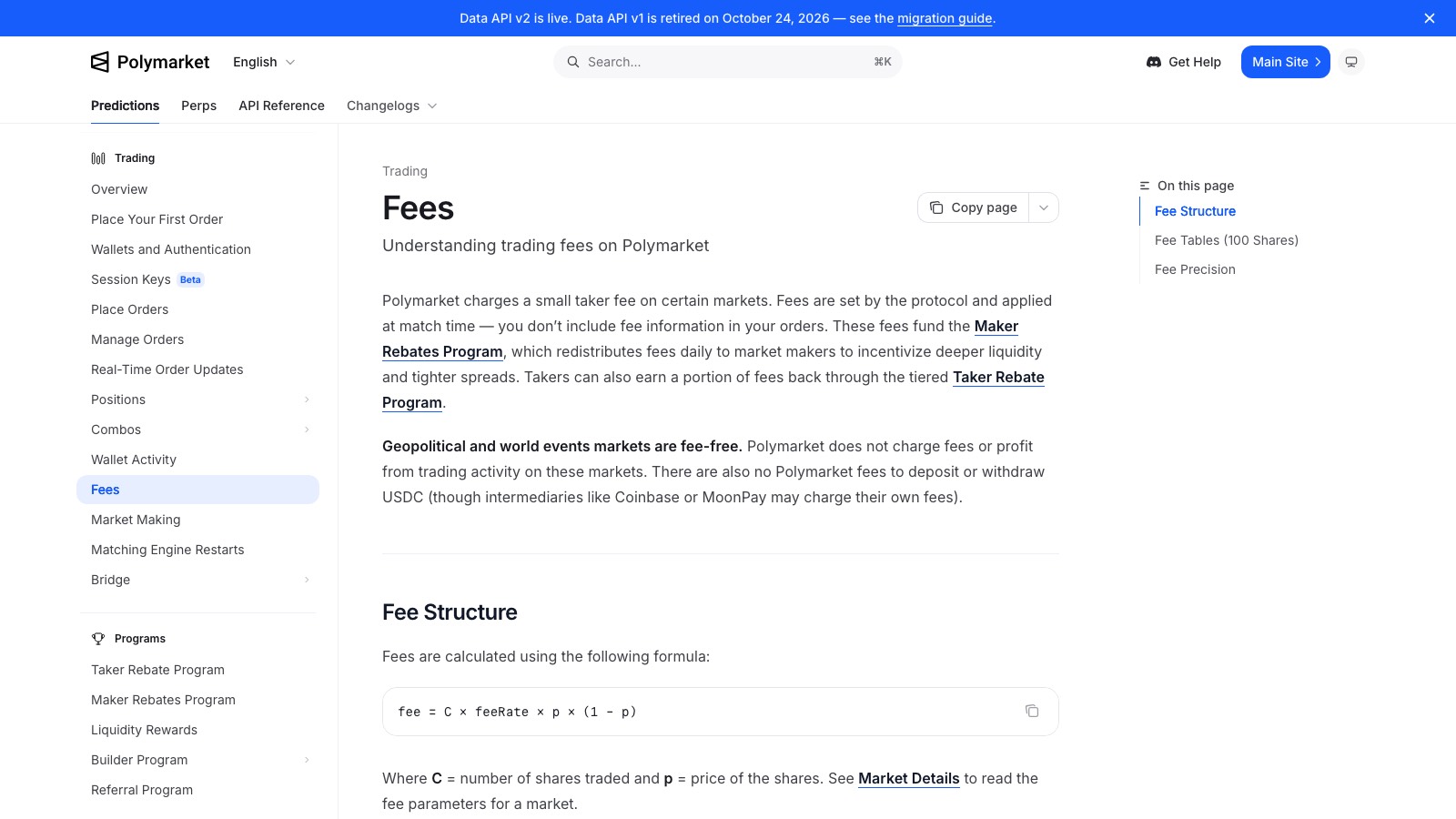
Polymarket publishes one formula for every market that charges a fee:
fee = C * rate * p * (1-p)
C is the number of shares and p is the price. Because the fee depends on
p × (1 − p), it peaks at 50¢ and falls away symmetrically toward both ends, a
trade at 30¢ costs exactly the same as one at 70¢. At the extremes it rounds to
nothing.
The rate itself depends on the market's category.
Rates by category
| Category | Taker rate | Fee per 100 shares at 50¢ |
|---|---|---|
| Crypto | 0.07 | $1.75 |
| Sports | 0.05 | $1.25 |
| Finance, Politics, Mentions, Tech | 0.04 | $1.00 |
| Economics, Culture, Weather, Other | 0.05 | $1.25 |
| Geopolitics and world events | 0 | $0.00 |
Makers pay nothing in every category. Geopolitics and world-events markets are fee-free on both sides, Polymarket says plainly that it does not profit from trading activity on them.
The tier that is not in any published table
Polymarket's fee page lists those rate bands and nothing else. Its live API carries one more.
Long-dated sports outrights, "who wins the competition" rather than "who wins this match", report a taker rate of 0.03, not the 0.05 the published Sports table is built on. We observed it on the 2026-27 Champions League and Premier League winner markets, the men's US Open, and the Ballon d'Or.
For those markets, every cell of Polymarket's own Sports table overstates the fee. At 50¢ the real taker fee is $0.75 per 100 shares against the $1.25 the table shows, the published number is five-thirds of the true one.
This matters beyond Polymarket. Secondary sources that quote "Sports 0.03" are not out of date, as is usually assumed; they are describing a real tier that the documentation omits. Both figures are live at the same time, for different market types.
Fee by price, per 100 shares
| Price | Crypto | Sports | Finance / Politics / Mentions / Tech | Economics / Culture / Weather / Other | 0.03 outright |
|---|---|---|---|---|---|
| $0.01 | $0.07 | $0.05 | $0.04 | $0.05 | $0.03 |
| $0.05 | $0.33 | $0.24 | $0.19 | $0.24 | $0.14 |
| $0.10 | $0.63 | $0.45 | $0.36 | $0.45 | $0.27 |
| $0.15 | $0.89 | $0.64 | $0.51 | $0.64 | $0.38 |
| $0.20 | $1.12 | $0.80 | $0.64 | $0.80 | $0.48 |
| $0.25 | $1.31 | $0.94 | $0.75 | $0.94 | $0.56 |
| $0.30 | $1.47 | $1.05 | $0.84 | $1.05 | $0.63 |
| $0.35 | $1.59 | $1.14 | $0.91 | $1.14 | $0.68 |
| $0.40 | $1.68 | $1.20 | $0.96 | $1.20 | $0.72 |
| $0.45 | $1.73 | $1.24 | $0.99 | $1.24 | $0.74 |
| $0.50 | $1.75 | $1.25 | $1.00 | $1.25 | $0.75 |
| $0.55 | $1.73 | $1.24 | $0.99 | $1.24 | $0.74 |
| $0.60 | $1.68 | $1.20 | $0.96 | $1.20 | $0.72 |
| $0.65 | $1.59 | $1.14 | $0.91 | $1.14 | $0.68 |
| $0.70 | $1.47 | $1.05 | $0.84 | $1.05 | $0.63 |
| $0.75 | $1.31 | $0.94 | $0.75 | $0.94 | $0.56 |
| $0.80 | $1.12 | $0.80 | $0.64 | $0.80 | $0.48 |
| $0.85 | $0.89 | $0.64 | $0.51 | $0.64 | $0.38 |
| $0.90 | $0.63 | $0.45 | $0.36 | $0.45 | $0.27 |
| $0.95 | $0.33 | $0.24 | $0.19 | $0.24 | $0.14 |
| $0.99 | $0.07 | $0.05 | $0.04 | $0.05 | $0.03 |
How Polymarket compares
Polymarket, Kalshi, Robinhood and Novig all price on the same curve. What separates them is the constant, and what each one bolts on top. Per 100 contracts at 50¢:
| Venue and trade type | Fee per 100 at 50¢ |
|---|---|
| Novig, pre-game straight | $0.00 |
| Polymarket, sports outright (live, undocumented) | $0.75 |
| Novig, live in-game straight | $0.75 |
| Robinhood, either tier (capped) | $1.00 |
| Polymarket, sports / economics | $1.25 |
| Kalshi, standard taker | $1.75 |
| Polymarket, crypto | $1.75 |
| Robinhood, including exchange fee | $2.00 |
| Novig, parlay | $2.50 |
Two entries there are not in any published comparison. Polymarket's 0.03 outright tier is absent from its own tables, and Robinhood's true cost only appears once you add the exchange fee it discloses separately from the commission it advertises.
Kalshi's standard rate is the same 0.07 as Polymarket's crypto tier, but Kalshi rounds up to the cent where Polymarket rounds to nearest, so the two published tables disagree by a cent at several prices. That is covered on the Kalshi fees page.
What Polymarket does not charge for
- Makers. Never, in any category.
- Geopolitics and world events. Fee-free on both sides.
- Deposits and withdrawals of USDC. Polymarket charges nothing. An intermediary such as Coinbase or MoonPay may charge its own fee, and the bridge itself takes time, see Polymarket withdrawals.
A detail worth knowing if you build on this
Polymarket's API exposes a fee parameter its published formula does not mention: an exponent applied to the price component. On every market we sampled it is set to 1, which collapses the general form back to the published formula, so the published formula is correct today, but it is not the whole model. A market with a different exponent would price differently while the fee page stayed exactly as written.
The endpoint named /fee-rate is also misleading: it returns a legacy
basis-point field that reads the same on markets whose real rates differ. The
figure that matters is on the market object itself.


